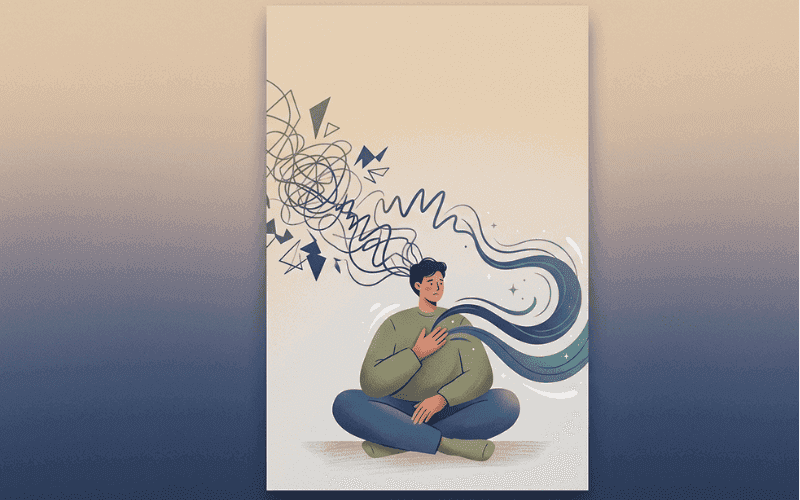
You know that moment when everything feels normal, then suddenly your body reacts like there is danger right in front of you. Your heart starts pounding, your breathing changes, your thoughts speed up, and it feels like you are losing control even if nothing around you explains it.
Anxiety attacks can feel overwhelming because they don't always follow logic. They come fast, sometimes without warning, and they push you into a state where your body reacts before your mind can catch up. In those moments, what matters most is not overthinking, but knowing what to do immediately to help your system calm down.
This guide gives you clear, practical, and realistic methods you can use when anxiety hits. These are simple techniques focused on helping you regain control step by step, without needing complicated tools or preparation.
What Is Happening During an Anxiety Attack
Before you can manage an anxiety attack, you need to understand what your body is doing. An anxiety attack is basically your nervous system going into overdrive. Your brain detects a threat, even if there is no real danger, and activates a survival response known as fight or flight.
During this response, your body releases stress hormones like adrenaline. That is what causes the fast heartbeat, tight chest, sweating, and shaky feeling. Your mind may also start creating worst-case scenarios, which makes everything feel even more intense.
Common signs include:
- Rapid heartbeat and chest pressure
- Shortness of breath or feeling like you cannot get enough air
- Dizziness or lightheadedness
- Feeling disconnected from reality
- Fear that something bad is going to happen
Even though it feels serious, an anxiety attack is not dangerous by itself. It is your body reacting too strongly to stress signals.
1. Controlled Breathing to Slow Down Your System
When anxiety starts building, your breathing usually becomes shallow and fast. This tells your brain that something is wrong, which keeps the cycle going. The fastest way to interrupt this loop is to slow your breathing on purpose.
You can try this method:
Breathe in slowly through your nose for 4 seconds. Hold your breath gently for 4 seconds. Exhale slowly through your mouth for 6 to 8 seconds. Repeat this for a few minutes.
The goal is not perfection. The goal is rhythm. When your exhale becomes longer than your inhale, your nervous system starts shifting out of stress mode.
This technique is widely used in relaxation training and is supported by research on how breathing affects the parasympathetic nervous system, which is responsible for calming the body.
2. Grounding Yourself in the Present Moment
Anxiety pulls your attention into thoughts that are not happening right now. Grounding brings you back to the present by using your senses.
A simple method you can use anywhere is the 5-4-3-2-1 technique:
You look around and identify five things you can see. You notice four things you can physically feel. You listen for three sounds around you. You identify two things you can smell. You focus on one thing you can taste.
This method works because it interrupts the mental spiral and forces your brain to reconnect with real-time information instead of fear-based thoughts.
It is commonly used in cognitive behavioral therapy and trauma recovery techniques because it helps stabilize emotional intensity quickly.
3. Using Cold Sensation to Interrupt Panic
When your body is in panic mode, strong physical sensations can reset the stress response. Cold exposure is one of the simplest ways to do this.
You can:
- Splash cold water on your face
- Hold something cold like an ice cube
- Drink cold water slowly and focus on the sensation
The sudden temperature change activates a reflex in your nervous system that helps slow down heart rate and reduce intensity.
This works because your body cannot stay fully in panic mode when it is processing strong sensory input at the same time.
4. Question the Thoughts Instead of Believing Them
During an anxiety attack, your mind can create thoughts that feel very real. You might think something is wrong with your health, your safety, or your future. The problem is that anxiety does not present balanced thoughts. It presents worst-case scenarios.
Instead of accepting those thoughts immediately, you can challenge them gently.
Ask yourself:
- Is this thought a fact or a fear
- What proof do I actually have right now
- Have I felt this before and was I okay afterward
This is not about forcing positive thinking. It is about slowing down mental reactions so you are not fully controlled by fear-based interpretations.
This approach comes from cognitive behavioral therapy, which focuses on changing how you respond to thoughts rather than trying to eliminate them.
5. Release Physical Tension in Your Body
Anxiety is not only mental. It lives in your body too. Your muscles tighten without you noticing, especially in your shoulders, jaw, and hands.
A simple way to release that tension is progressive relaxation:
Tighten your shoulders for a few seconds, then release. Clench your fists tightly, then let go. Lift your shoulders up, hold, then drop them. Slowly move through different parts of your body.
When your muscles relax, your brain receives a signal that the danger is decreasing. This helps reduce the physical intensity of anxiety.
6. Shift Your Attention Away From the Spiral
Anxiety grows when your attention stays locked on fear. Breaking that focus is essential.
You can redirect your mind using simple tasks like:
- Counting backwards from 100 in steps of 7
- Focusing deeply on a nearby object and describing it in detail
- Listening carefully to background sounds without judging them
These tasks are not about distraction for avoidance. They are about giving your brain something neutral to process so it stops feeding the anxiety loop.
Attention control is a key part of managing stress responses because your brain cannot fully focus on fear and external tasks at the same time.
7. Move Your Body to Release Stress Energy
Anxiety creates energy in your system. If that energy stays trapped, it continues to feel uncomfortable. Movement helps release it.
You do not need intense exercise. Simple movement is enough:
- Walk slowly for a few minutes
- Stretch your arms and legs
- Shake your hands gently
- Roll your neck and shoulders
This helps your body process excess adrenaline and signals that the danger response can slow down.
Even light movement can make a noticeable difference in how quickly your system calms.
8. Use Calming Self-Talk That Grounds You
The way you speak to yourself during anxiety matters more than you might realize. When fear increases, your inner dialogue often becomes harsher or more dramatic.
Instead of feeding that pattern, use steady and calming statements like:
- This feeling will pass
- My body is reacting, but I am safe
- I have experienced this before and I got through it
- I do not need to solve everything right now
Repeating simple phrases helps reduce emotional intensity because it gives your mind a stable reference point during chaos.
9. Reduce External Overload Immediately
Sometimes anxiety increases because your environment is too stimulating. Bright screens, noise, and multitasking can make symptoms worse.
To help your system settle:
- Move to a quieter space if possible
- Reduce screen brightness or turn it off
- Lower background noise
- Sit down and remove unnecessary stimulation
Your nervous system calms faster when it is not processing too much input at once.
10. Build Long-Term Stability to Reduce Future Attacks
While fast techniques help in the moment, long-term habits reduce how often anxiety attacks happen.
You can focus on:
- Getting consistent sleep each night
- Reducing caffeine intake if it increases symptoms
- Practicing breathing exercises daily, even when calm
- Staying physically active in a sustainable way
- Creating routines that make your day predictable
Over time, your nervous system becomes less reactive, which means fewer intense episodes and faster recovery when they do happen.
FAQ: 10 Proven Ways to Stop Anxiety Attacks Fast
How long does an anxiety attack usually last?
Most anxiety attacks last between a few minutes and around 20 to 30 minutes, depending on stress levels and environment.
What is the fastest way to stop an anxiety attack?
Controlled breathing combined with grounding techniques is often the quickest way to reduce symptoms in the moment.
Are these techniques enough to stop every anxiety attack?
They help manage and reduce intensity, but results can vary depending on the person and situation.
Can anxiety attacks happen without warning?
Yes, they can appear suddenly even without an obvious trigger because the nervous system may react to internal stress signals.
Should I seek help if anxiety attacks happen often?
If anxiety attacks are frequent or interfere with daily life, speaking with a qualified mental health professional can be helpful.
Call to Action
If this guide helped you understand how to handle anxiety attacks better, take one technique and practice it today, even when you are calm. The more familiar your body becomes with these methods, the faster they will work when you actually need them.
You can also bookmark this article so you have a clear plan the next time anxiety shows up unexpectedly.
Conclusion: You Can Learn to Respond Differently
Anxiety attacks feel intense, but they are temporary responses from your nervous system. The key is learning how to guide your body and mind back to balance instead of reacting with fear.
When you use these techniques consistently, you start to notice a shift. The attacks may not disappear overnight, but they lose their power over you. You begin to recognize what is happening, and that awareness alone changes everything.
You are not trying to eliminate anxiety completely. You are learning how to move through it without losing control.