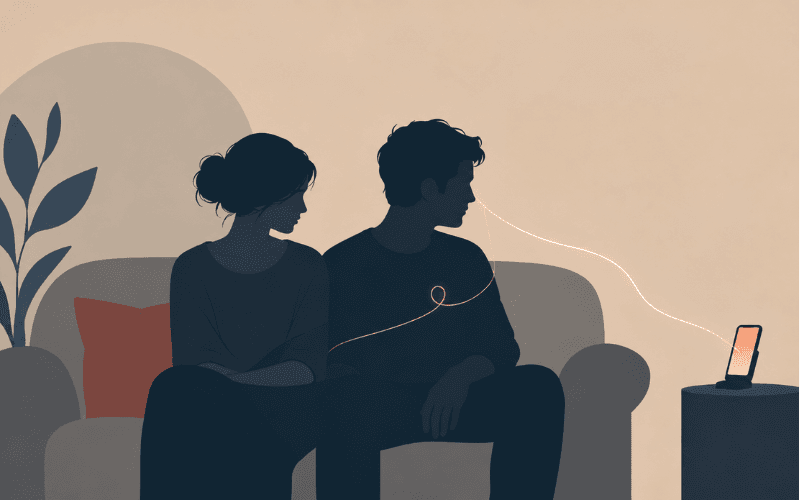
You haven't kissed anyone else. You haven't even held hands. But there's a name on your phone that makes your heart skip a little faster, and somewhere along the way, you started sharing things with them that you no longer share with your partner.
If that scenario feels uncomfortably familiar, you're not alone, and you're not imagining that something is wrong. Society has trained most of us to think of cheating as a physical act, a single moment of crossed boundaries. But emotional cheating doesn't announce itself that way. It creeps in through late-night texts, inside jokes, and the quiet relief of feeling understood by someone who isn't your partner. And it can hurt just as much, if not more, than physical infidelity.
This article walks you through what emotional cheating actually is, how to recognize the warning signs, why it happens in the first place, and what you can do about it — whether you're the one who strayed emotionally or the one left wondering why you suddenly feel like a stranger in your own relationship.
What Is Emotional Cheating, Exactly?
At its core, emotional cheating happens when you form a close, intimate connection with someone outside your relationship — a connection that involves the kind of emotional investment, vulnerability, and secrecy that's typically reserved for your partner. There's no physical touch involved, which is exactly why it's so easy to rationalize and so hard to define.
What separates emotional cheating from an ordinary friendship usually comes down to three things: intensity, secrecy, and displacement. You're not just enjoying someone's company — you're actively hiding the depth of the connection, and you're redirecting emotional energy away from your partner and toward this other person.
Here's the part that might surprise you: most people don't need a formal definition to know when something has crossed a line. National survey data backs this up. In a nationally representative sample of 2,000 U.S. adults, 76% of respondents felt that a married person having a secret emotional relationship in real life constituted a form of infidelity, and 72% said the same about a secret online emotional relationship. In other words, most people already believe that sexual contact isn't a requirement for something to count as betrayal.
Every couple gets to define their own boundaries, but the common thread across nearly every definition is this: if you'd feel the need to hide it, delete it, or downplay it, that's usually a sign it's more than "just friends."
Emotional Cheating vs. Physical Cheating: What's the Real Difference?
It's tempting to rank one form of betrayal as "worse" than the other, but the truth is more complicated than that.
What they have in common:
- Both involve secrecy and deception
- Both violate the trust and exclusivity a couple has agreed to
- Both redirect intimacy — emotional, physical, or both — away from the relationship
What sets them apart:
- Physical cheating centers on sexual or physical contact
- Emotional cheating centers on intimacy, vulnerability, and emotional dependency
- Emotional affairs often build gradually, while physical affairs can happen in a single decision
Interestingly, when people are asked which type of betrayal would hurt more, the answers split sharply by gender. One analysis found that 64% of couples believe an emotional affair can be just as damaging, or even more harmful, than a physical one, and that women in particular find emotional infidelity devastating, with 73% saying it would upset them more than physical cheating. That's a meaningful data point, because it challenges the old assumption that "nothing happened" makes emotional betrayal less serious.
Signs of Emotional Cheating: Red Flags Worth Paying Attention To
You don't need proof of a physical affair to trust that something feels off. Here are some of the most common warning signs therapists point to when discussing emotional infidelity:
1. Secrecy around their phone
They turn the screen away, delete conversations, or get defensive when you're nearby during a text exchange.
2. Unfavorable comparisons
They mention how "easy" it is to talk to this other person, or how they "just get it" in a way you supposedly don't.
3. They share the big stuff with someone else first
A promotion, a bad day, a personal fear — you find out you were the last to know.
4. Emotional and physical distance at home
Conversations feel shallow, affection drops off, and you sense a wall going up.
5. Protectiveness over their time with this person
They get irritated if you ask questions or suggest limiting contact.
6. Guilt or defensiveness when confronted
An innocent question gets met with disproportionate anger or over-explanation.
7. Daydreaming or preoccupation
Their mind seems to wander to this person even when they're physically with you.
Why Does Emotional Cheating Happen?
Emotional affairs rarely start with the intention to betray anyone. They usually start small, and they tend to grow out of a handful of common root causes.
- Unmet emotional needs. When you feel unheard, unappreciated, or emotionally alone in your relationship, it creates a vulnerability that someone else can unintentionally — or intentionally — fill.
- Major life stress and transitions. New parenthood, career pressure, illness, or grief can pull partners apart at exactly the moment they need each other most.
- Conflict avoidance. Instead of addressing tension at home, it can feel easier to seek validation and connection somewhere that feels conflict-free.
- Reconnecting with the past. Old flames and former friends who resurface, often through social media, can reignite feelings tied to nostalgia and unfinished business.
- Proximity and shared stress. Coworkers who spend long hours together, especially during high-pressure projects, often develop closeness that can tip into something more.
- General relationship dissatisfaction. Feeling stuck, bored, or unfulfilled makes people more susceptible to seeking that spark elsewhere.
Research consistently shows that infidelity — emotional or physical — is rarely just about the state of the relationship. One breakdown of motivations identified factors including anger, low self-esteem, feeling neglected, a need for variety, and simple situational opportunity as drivers, independent of whether someone actually considered their relationship happy. In fact, some data suggests a notable share of people who stray still rate their relationships positively overall, which underscores that emotional cheating is often more about an individual's internal vulnerabilities than a verdict on the relationship itself.
It's also worth noting that emotional affairs aren't rare. Some estimates suggest that when emotional infidelity is factored in alongside physical infidelity, the numbers climb well above what most people assume — with certain surveys putting combined rates at roughly 45% for men and 35% for women. Whatever the exact figure, the pattern is clear: emotional cheating is common enough that you're far from alone if you're navigating it, on either side.
The Real Impact of Emotional Cheating on a Relationship
Because there's no physical act to point to, emotional cheating can feel harder to justify being upset about — but the damage it causes is very real.
- Trust erodes quickly. Discovering an emotional affair often triggers the same grief and betrayal response as discovering a physical one.
- The betrayed partner often experiences lasting anxiety. Obsessive thoughts, hypervigilance, and self-doubt are common, and researchers refer to this pattern as betrayal trauma — a recognized psychological response to broken trust from someone you depended on.
- Resentment builds if it goes unaddressed. Left unspoken, emotional cheating tends to widen the emotional gap it started from, sometimes leading to separation.
- Self-worth can take a hit. It's common for betrayed partners to internalize the affair, wondering what they lacked or did wrong, even when the root cause had little to do with them.
None of this means the relationship is doomed. It means the wound deserves the same seriousness and care that a physical affair would receive.
Is Emotional Cheating Considered "Real" Cheating?
This is one of the most debated questions in modern relationships, and reasonable people land in different places.
Some argue that without physical contact, nothing has technically "happened," and that emotional closeness with other people is a normal part of being human. Others, including most relationship therapists, argue that betrayal of emotional exclusivity is still betrayal — because it involves the same ingredients as physical cheating: secrecy, deception, and emotional investment redirected away from the relationship.
The data leans heavily toward the second view. As mentioned earlier, roughly three in four Americans consider a secret emotional relationship to be a form of infidelity, whether it happens in person or online. That said, the healthiest approach isn't to rely on a national average — it's for you and your partner to define your own boundaries clearly, ideally before a gray area turns into a crisis.
How to Address Emotional Cheating in Your Relationship
If emotional cheating has entered your relationship, how you handle the next steps matters enormously.
If You're the One Who Emotionally Cheated
- Own it honestly, even if it feels easier to minimize or explain it away.
- Cut off or significantly limit contact with the other person — ambiguity here will keep the wound open.
- Get curious about what unmet need drove the connection in the first place.
- Be transparent with your partner, even when the conversation is uncomfortable. Half-truths tend to cause more damage than the original affair.
If Your Partner Emotionally Cheated
- Let yourself feel hurt. Emotional betrayal is a legitimate loss, not an overreaction.
- Communicate your boundaries clearly instead of assuming your partner already knows where the line is.
- Consider couples counseling as a structured way to rebuild trust rather than trying to "just move on."
- Resist the urge to constantly monitor their phone or whereabouts — it's a natural instinct, but it tends to prolong the healing process rather than speed it up.
How to Prevent Emotional Cheating Before It Starts
Prevention is almost always easier than repair. A few habits can go a long way:
- Make regular emotional check-ins a habit, not just a crisis response.
- Set clear boundaries with friends or coworkers where a romantic undertone could develop.
- Address dissatisfaction in your relationship early, instead of letting it quietly build.
- Prioritize shared time and activities that keep your emotional connection active.
- Consider couples counseling proactively — not only when something has already gone wrong.
When to Seek Professional Help
If emotional cheating has already happened, or if you sense your relationship sliding toward it, professional support can make a significant difference. Couples therapy approaches like the Gottman Method or Emotionally Focused Therapy (EFT) are specifically designed to rebuild trust and repair emotional disconnection. Individual therapy can also help the betrayed partner process betrayal trauma, and it can help the partner who strayed understand the deeper needs that went unmet.
Recovery data is genuinely encouraging here: research on couples who pursued therapy after infidelity found a strong majority were able to rebuild their relationship successfully. In other words, emotional cheating doesn't have to be the end of the story — but it usually requires more than good intentions to move past it.
Conclusion
Emotional cheating doesn't leave physical evidence, but it leaves real damage — broken trust, quiet grief, and a relationship that can feel unfamiliar even when nothing "technically" happened. Recognizing it for what it is, rather than minimizing it, is the first step toward healing.
Whether you're trying to understand your own behavior or trying to make sense of your partner's, the path forward is the same: honesty, clear boundaries, and a willingness to do the harder, more vulnerable work of reconnecting. Relationships can and do recover from emotional cheating, but only when both people choose to face it directly instead of around it.
If you're standing in the middle of this right now, unsure of what to say or where to start, consider reaching out to a licensed couples therapist. A single honest conversation, guided by the right support, can be the turning point that changes everything.
Frequently Asked Questions About Emotional Cheating
Is emotional cheating the same as having a close friendship?
Not necessarily, and the difference usually comes down to secrecy and displacement rather than closeness alone. Healthy friendships are typically open — your partner knows about them, and they don't come at the cost of your relationship's intimacy. Emotional cheating, on the other hand, tends to involve hiding the depth of the connection and redirecting emotional energy that would normally go to your partner. If you find yourself editing what you share about a friendship, that's often a signal worth paying attention to.
Can emotional cheating turn into physical cheating?
It can, though it doesn't always. Emotional affairs often build a foundation of trust, vulnerability, and secrecy that can make a physical step feel like a natural next move, especially once boundaries have already been blurred. That said, many emotional affairs never become physical, particularly when they're addressed early. The risk tends to rise the longer the connection stays hidden and unaddressed.
How do you know if you're emotionally cheating without realizing it?
A useful gut check is to ask yourself whether you'd be comfortable showing your partner every message you've exchanged with this person. If the answer is no, or if you've caught yourself minimizing the relationship when it comes up, those are strong signs. Other clues include looking forward to time with this person more than time with your partner, or finding yourself emotionally drained by your relationship but energized by this other connection.
Can a relationship survive emotional cheating?
Yes, and many do, particularly when both partners are willing to engage honestly with what happened. Recovery usually requires transparency from the partner who strayed, patience and clear communication from the betrayed partner, and often professional support to rebuild trust in a structured way. It's rarely quick, but a relationship isn't automatically over because emotional cheating occurred.
What's the difference between emotional cheating and micro-cheating?
Micro-cheating generally refers to smaller, boundary-testing behaviors, like flirtatious comments or maintaining a suggestive social media presence with someone outside the relationship. Emotional cheating tends to go further, involving a sustained, secretive emotional investment that displaces intimacy from your primary relationship. Micro-cheating can be an early warning sign, but it isn't automatically the same as a full emotional affair.