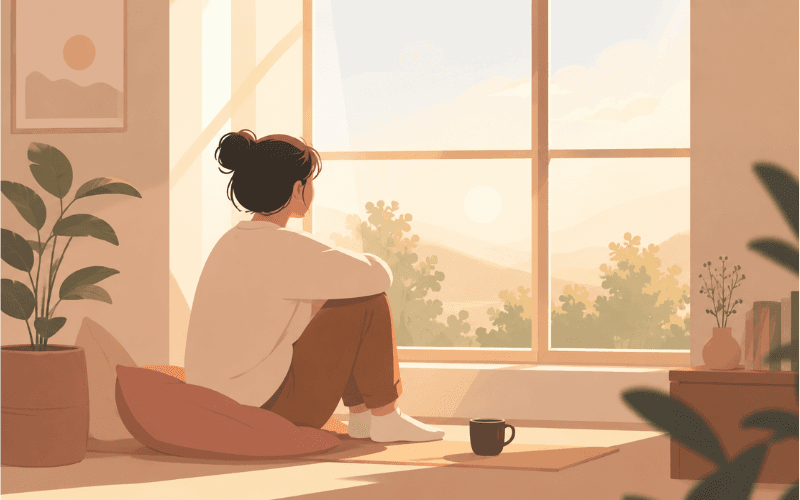
It probably hit you somewhere ordinary. Maybe you were standing in the shower, letting the water run longer than it needed to. Maybe you were driving home on autopilot, half-listening to the radio. Or maybe it was 2 a.m., and your brain decided that was the perfect moment to hand you a thought you weren't asking for.
That's how it usually goes. You're not trying to have a breakthrough. You're just living your life, and then, out of nowhere, something clicks. A random realization lands, and suddenly a piece of your life looks different than it did five minutes ago.
If you've ever had one of those moments — where a small, unplanned thought quietly rearranged how you see yourself, your relationships, or your day — you already know how powerful they can be. This article is a collection of 35 of them. Not grand life lessons delivered from a mountaintop, but small, honest insights that tend to show up when you least expect them and stay with you long after.
Read through them slowly. Some will feel obvious. Others might catch you off guard. Either way, by the end, you'll have a fuller toolkit for quieting the noise in your head and looking at your life with a little more clarity.
What Are Random Realizations (and Why They Matter)
A random realization is exactly what it sounds like: an insight that surfaces without warning, usually while your mind is doing something else entirely. You're not sitting down to journal or meditate. You're brushing your teeth, folding laundry, or staring out a train window, and your brain quietly connects a few dots on its own.
There's a reason this happens so often during "boring" moments. When your mind isn't locked onto a task, it shifts into what researchers call the default mode network — a state associated with daydreaming, memory processing, and self-reflection. Psychologists studying mind-wandering have found that people spend a significant portion of their waking hours with their minds drifting away from the task in front of them, and it's often during this drifting that unexpected clarity shows up.
In other words, your best thinking doesn't always happen when you're trying hardest to think. Sometimes it happens when you finally stop trying.
Here's how to tell if you're overdue for one of these moments:
- You keep comparing your life to everyone else's highlight reel
- Being present feels harder than it used to
- The same anxious "what if" thought keeps looping in your head
- You feel stuck, even though nothing dramatic is actually wrong
If any of that sounds familiar, keep reading. These next 35 realizations are meant to interrupt that loop.
35 Random Realizations to Shift Your Mindset
Realizations About Time and Mortality
- You will never be this exact age again. Not next year, not next week — this version of you, right now, is temporary. That's not meant to scare you; it's meant to make today feel a little less disposable.
- Most of what you're stressed about today, you won't remember in five years. Your brain compresses time and edits out the noise. What feels urgent now often fades into a blur later.
- Time doesn't actually speed up — your perception of it does. As you age, fewer experiences feel "new," so your brain logs less detail, which makes years feel shorter in hindsight.
- You're closer to the end of some chapters than you think. This isn't morbid — it's a nudge to stop postponing the things that matter to you.
- Waiting for "the right time" often means waiting forever. The right time is frequently just the moment you decide to stop waiting.
Realizations About Self-Worth and Comparison
- Everyone is figuring it out as they go. Nobody actually has it all together; some people are just better at appearing that way.
- What you see online is a curated version of someone's life, not the whole thing. Comparing your daily reality to someone's highlight reel is a losing game by design.
- You are the only person keeping score of your own life. Other people are far too busy thinking about themselves to be quietly ranking you.
- Your worst moments don't define your worth — they're just moments. A bad week doesn't cancel out who you are.
- Confidence is often just practiced familiarity, not natural talent. The people who seem sure of themselves usually just did the uncomfortable thing enough times that it stopped being uncomfortable.
A few quick reminders to break a comparison spiral:
- Mute or unfollow accounts that consistently make you feel "less than"
- Ask whether you're comparing your behind-the-scenes to someone else's highlight reel
- Redirect the comparison inward: how do you compare to who you were a year ago?
Realizations About Relationships and People
- Most people are too focused on themselves to be judging you as closely as you think. Psychologists call this the spotlight effect — we tend to dramatically overestimate how much others notice us.
- Most conflict comes from misunderstanding, not malice. People rarely set out to hurt you; they're usually just reacting from their own stress or fear.
- You can love someone deeply and still need space from them. Distance isn't always a sign that something is broken.
- Silence in a relationship is not always a bad sign. Comfortable quiet is often a sign of trust, not disconnection.
- The people who truly care about you rarely need convincing. If you're constantly proving your worth to someone, that's information in itself.
Realizations About Failure and Growth
- Failure is feedback, not a verdict on who you are. It tells you what didn't work, not what you're worth.
- Most "overnight successes" took years you simply didn't witness. You're usually only seeing the finished result, not the long, unglamorous process behind it.
- Discomfort is often a sign you're growing, not a sign something's wrong. Growth rarely feels smooth while it's happening.
- You don't need to feel ready to start. Readiness is often something you build by starting, not something you wait for.
- The lesson usually shows up after the hard part, not during it. Give yourself permission to understand things in hindsight.
Quick ways to reframe failure in the moment:
- Ask, "What is this actually teaching me?" instead of "Why did this happen to me?"
- Separate the outcome from your identity — a failed attempt isn't a failed person
- Remind yourself that discomfort now often means growth later
Realizations About Happiness and Contentment
- Happiness tends to live in ordinary moments, not major milestones. A quiet coffee, a good laugh, a walk outside — these often outweigh the big wins you were chasing.
- The harder you chase happiness, the more it can slip away. This mirrors what psychologists describe as hedonic adaptation — we quickly get used to new circumstances and reset our baseline.
- Gratitude changes your perspective faster than your circumstances do. Research on gratitude journaling has repeatedly linked the practice to improved mood and reduced stress, even when nothing external changes.
- Contentment isn't the absence of desire — it's the presence of appreciation. You can want more and still be genuinely thankful for what you already have.
- Comparing your happiness to someone else's is like comparing chapters from two different books. Your timeline was never meant to match anyone else's.
Realizations About Letting Go and Control
- You can control your effort. You can't control the outcome. Once you accept this, a lot of anxiety loses its grip.
- Holding on tightly to something often causes more pain than the loss itself. Sometimes the fear of losing something hurts worse than actually losing it.
- Some doors close so better ones can open — but you still have to walk toward them. Nothing changes by standing still and waiting.
- Forgiveness is more about your peace than the other person's apology. You can let go of resentment without waiting for someone else to earn it.
- Not everything deserves your energy. Choosing what to let go of is just as important as choosing what to hold onto.
Realizations About the Present Moment
- The present moment is the only one you actually have. The past is memory, the future is imagination — right now is the only place life is actually happening.
- Multitasking often feels productive while actually slowing you down. Studies on divided attention consistently show that switching between tasks costs more time and focus than it saves.
- Boredom is often where your best ideas are hiding. When your mind isn't overstimulated, it finally has room to wander into something useful.
- Noticing small details is a skill, not a personality trait. The more you practice paying attention, the more your day naturally slows down.
- You don't need a special occasion to feel grateful right now. This exact, unremarkable moment is still worth noticing.
Three simple ways to catch more of these moments:
- Leave space in your day without a screen — a walk, a shower, a commute
- Keep a note open on your phone to jot down thoughts before they disappear
- Ask yourself once a day, "What did I notice today that I hadn't before?"
How to Turn Random Realizations Into Lasting Mindset Shifts
Having a realization is one thing. Keeping it is another. Insights like these tend to fade fast unless you give them somewhere to land. Here's how to hold onto them:
- Keep a running note on your phone. Whenever a thought hits you, capture it in a few words before it slips away.
- Journal for five minutes after a moment of clarity. You don't need a polished entry — just enough to remember why it mattered.
- Revisit your list once a month. Reading old realizations often reveals patterns you didn't notice the first time.
- Say it out loud to someone. Sharing an insight in conversation tends to cement it more than keeping it in your head.
- Protect quiet moments on purpose. Since most of these thoughts surface during downtime, giving yourself more unstructured time means giving yourself more chances to have them.
Why Random Realizations Are Good for Your Mental Health
There's a real, practical payoff to paying attention to these moments. Reflective thinking has been linked to lower stress and greater emotional clarity — expressive writing research, for example, has shown that simply putting thoughts into words can ease psychological tension, even when the situation itself hasn't changed.
Random realizations work in a similar way. They interrupt the automatic loop of overthinking and replace it, even briefly, with perspective. Instead of spiraling on the same worry, you get a moment of distance from it. Over time, collecting these small insights can genuinely reshape how resilient, self-aware, and calm you feel day to day. It's not about forcing a positive mindset — it's about giving yourself more chances to see things clearly.
Frequently Asked Questions About Random Realizations
What are random realizations?
Random realizations are unplanned insights or moments of clarity that surface unexpectedly, often during routine activities like showering, walking, or driving, rather than during deliberate reflection.
Why do random realizations happen at unexpected times, like in the shower?
When your mind isn't focused on a specific task, it shifts into a more reflective state associated with daydreaming and memory processing. This relaxed mental state makes room for insights to surface naturally.
How can random realizations improve my mindset?
They interrupt repetitive, anxious thinking and offer fresh perspective on your habits, relationships, and goals. Over time, paying attention to them can reduce overthinking and build a calmer, more self-aware outlook.
How do I remember my random realizations so they don't just disappear?
Keep a note on your phone or a small journal nearby, and jot the thought down as soon as it happens. Revisiting these notes regularly helps reinforce the shift in perspective.
Are random realizations the same as epiphanies?
Not quite. Epiphanies tend to be rare and dramatic, while random realizations are smaller, quieter, and far more frequent — they show up in ordinary moments and add up over time rather than arriving all at once.
Final Thoughts
Mindset shifts rarely come wrapped in a single dramatic moment. More often, they build quietly — one small, random realization at a time. The 35 insights above aren't meant to be read once and forgotten. They're meant to be revisited, tested against your own life, and added to as you notice more of your own.
The next time a thought catches you off guard in the shower, on a walk, or in the middle of an otherwise unremarkable afternoon, don't brush it aside. Write it down. Sit with it. That small, random moment might be exactly what your mindset needed.
If one of these realizations struck a chord with you, save this list for the next time your thoughts feel loud, and share it with someone who might need a little perspective today too.