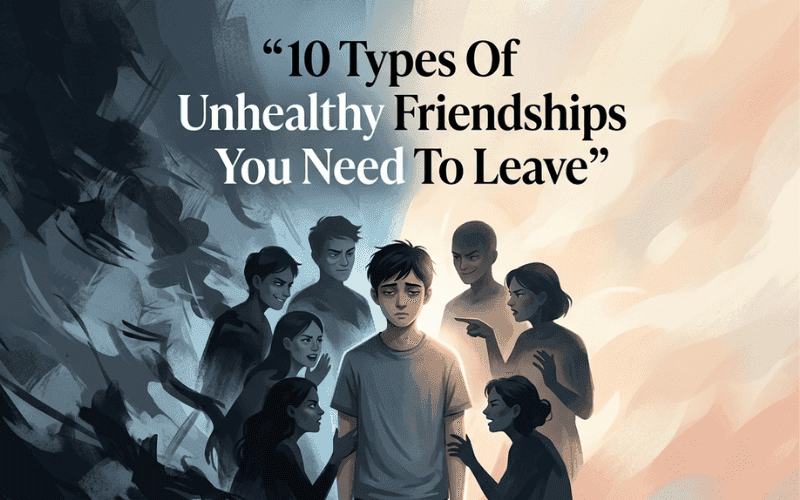
You don't always notice when a friendship starts hurting you. It rarely happens in a dramatic way. More often, it shows up in small moments: the way you feel tired after talking to someone, the way you hesitate before replying, or how you start questioning your own thoughts after certain conversations.
At first, you explain it away. Everyone has bad days. People are complicated. Maybe you are just overthinking.
But over time, something becomes clear. Some friendships don't support you. They slowly take from you.
Recognizing the 10 types of unhealthy friendships you need to leave is not about blaming others. It is about protecting your mental space, your confidence, and your emotional balance before they get worn down.
Why unhealthy friendships affect you more than you think
Human connection shapes how you see yourself. When you are surrounded by supportive people, your mind becomes more stable and confident. When you are around emotionally toxic dynamics, even subtly, your stress levels rise and your self-worth starts to shift downward.
Psychological research in social behavior shows that repeated exposure to criticism, manipulation, or emotional inconsistency can increase anxiety and reduce self-esteem over time. You don't just feel bad in the moment. You start carrying it with you.
That is why identifying these patterns early matters. It helps you stop normalizing what is actually harmful.
The one-sided friendship where you always give
You probably know this feeling. You are the one who checks in first. You are the one who remembers birthdays, starts conversations, and shows up when things go wrong. But when you need support, the energy disappears.
This type of friendship feels like effort without return. Over time, it creates emotional imbalance. You may even start doubting whether you are asking for too much, when in reality you are just not receiving basic reciprocity.
Healthy friendships do not require you to constantly prove your value.
The friend who constantly criticizes you
Some people disguise criticism as honesty. They say they are "just being real," but the effect is that you leave conversations feeling smaller than before.
Instead of support, you receive comments that question your decisions, your appearance, or your goals. Even when they sound subtle, they accumulate in your mind.
Real honesty does not leave you feeling diminished. It helps you grow without breaking your confidence. If you constantly feel judged instead of understood, the relationship becomes emotionally unsafe.
The friend who turns your success into competition
You share good news, hoping for happiness. Instead, you get comparison, silence, or a quick shift of attention back to them.
This type of friendship struggles to celebrate you without discomfort. Your progress becomes a trigger instead of a shared joy.
Over time, you may even start downplaying your achievements just to avoid tension. That is a sign the dynamic is no longer healthy. A real friend does not need you to shrink so they can feel okay.
The emotionally draining friend who leaves you exhausted
There are people who bring constant chaos into every conversation. Their problems are always urgent, their emotions always intense, and the space you give them is rarely returned.
After interacting with them, you feel mentally tired, even if nothing "bad" was said directly.
This is not about avoiding people who struggle. It is about recognizing when a relationship becomes a one-way emotional spill. When you are always the container for someone else's stress, your own emotional capacity starts to collapse.
The manipulative friend who uses guilt as control
This type of friendship is harder to identify because it often comes wrapped in emotional language. You might hear things that make you feel responsible for their feelings or choices.
If you set boundaries, they may react with guilt-tripping or silent punishment. You end up questioning yourself instead of their behavior.
Manipulation does not always look aggressive. Sometimes it feels like emotional pressure that makes you comply just to avoid conflict.
When guilt replaces mutual respect, the friendship stops being equal.
The friend who ignores your boundaries
Boundaries are not suggestions. They are limits that protect your well-being. But some friends treat them like obstacles.
They push you to do things you already said no to. They pressure you into situations that make you uncomfortable. They dismiss your limits as if they are not valid.
Over time, you may start giving in just to avoid tension. That slowly erodes your sense of control over your own decisions.
A respectful friendship does not require you to sacrifice your comfort.
The self centered friend who never truly listens
Conversations with this type of person feel like a constant shift back to them. Your experiences are briefly acknowledged, then redirected.
You may notice that your role in the friendship feels invisible unless it serves their narrative.
When you are repeatedly unheard, you start speaking less. Not because you have nothing to say, but because you have learned it will not be valued.
That silence is often the beginning of emotional withdrawal.
The hot and cold friend who confuses your emotions
One day they are close, warm, and engaged. The next, they disappear or act distant without explanation. This inconsistency creates emotional uncertainty.
You start overanalyzing your interactions, trying to figure out what changed. That mental loop becomes exhausting.
Stable friendships may have ups and downs, but they do not repeatedly destabilize your sense of connection. When you feel like you are constantly guessing where you stand, the relationship becomes emotionally unsafe.
The friend who only exists in old memories
Some friendships survive only because of history. You remember who you were together years ago, not who you are now.
Conversations feel forced. Connection feels outdated. Yet you stay attached because of shared experiences.
Growth sometimes separates people naturally. Staying in a friendship that no longer fits your life can prevent you from forming healthier connections that match who you are today.
The friend who gossips about everyone
A gossip focused friend creates a fragile sense of trust. If they speak badly about others to you, it raises a simple question: what do they say about you when you are not there
This pattern often builds a toxic environment where relationships are based on talking about people instead of connecting with them.
Over time, you may feel uneasy sharing personal thoughts, because you cannot be sure they will stay private.
Trust is the foundation of friendship. Without it, everything else becomes unstable.
How you start noticing it is time to let go
There is usually a moment where clarity starts to form. You begin to notice how you feel before and after interactions. If relief follows distance and tension follows contact, your emotional system is already giving you signals.
You may also realize you are shrinking yourself around certain people. You avoid topics, hide achievements, or filter your personality just to maintain peace.
When being yourself feels unsafe, something in the dynamic needs to change.
Letting go without creating unnecessary conflict
Leaving an unhealthy friendship does not always require confrontation. Sometimes distance is enough. You can slowly reduce emotional availability and observe what remains.
In other cases, a simple and calm conversation can close the chapter respectfully. You do not owe long explanations for choosing your well-being.
What matters most is consistency. If you decide to step back, you need to protect that decision even when emotions try to pull you back.
Conclusion
Not every friendship is meant to last forever. Some teach you lessons, others shape your early years, and a few quietly drain your energy until you no longer recognize how much you have been carrying.
Understanding the 10 types of unhealthy friendships you need to leave gives you something powerful: clarity. And clarity is often the first step toward emotional freedom.
You deserve relationships where you feel seen, supported, and safe without having to shrink yourself.
If this resonates with you, the next step is simple but not always easy. Start paying attention to how people make you feel, not just what they say. Your emotions are already telling you more than you think.