In fact, it was good news.
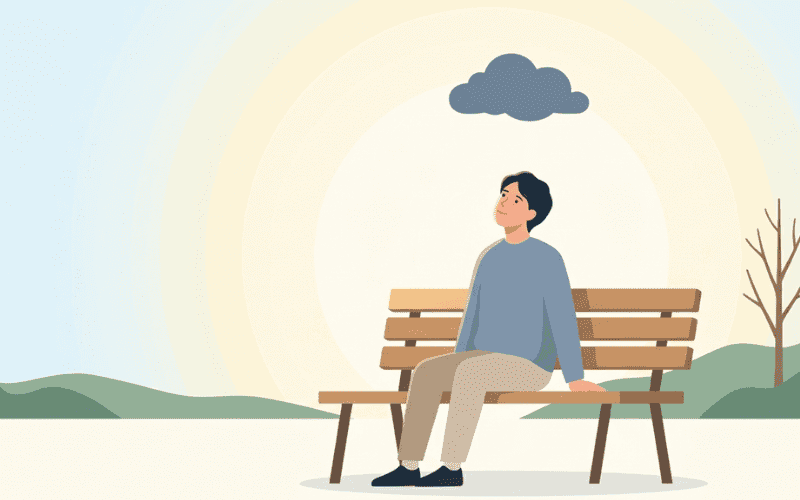
But somehow, as Sarah stared at her screen, her mind ignored the compliment and locked onto a tiny criticism buried in the last sentence. Within seconds, her excitement disappeared.
Sound familiar?
Sarah sat back in her chair, frustrated. She had just achieved something she'd worked months for. Yet instead of feeling proud, she felt anxious. Instead of joy, she felt doubt.
And she couldn't understand why.
For years, she thought something was wrong with her.
Why did her brain replay embarrassing moments from five years ago but forget yesterday's successes?
Why could one negative comment outweigh ten positive ones?
Why did happiness seem so temporary while worry stayed for free?
The answer surprised her.
It wasn't a personal flaw.
It was programming.
Thousands of years ago, your ancestors faced a very different world. Missing a beautiful sunset had no consequences. Missing a hidden predator could be fatal.
So the human brain evolved with one primary mission:
Not happiness.
Survival.
And survival required constant vigilance.
That's why your brain naturally scans for threats, problems, mistakes, and potential dangers. Psychologists often call this the negativity bias. It's the reason bad news grabs your attention faster than good news.
Your brain isn't asking, "How can I be happy today?"
It's asking, "What could go wrong?"
And that changes everything.
Once Sarah learned this, she began noticing the pattern everywhere.
A wonderful vacation would be overshadowed by a delayed flight.
A successful presentation would be ruined by one awkward moment.
A week of progress would be forgotten because of a single setback.
Each time, her brain acted like a security guard searching for danger.
The strange part?
The guard never clocks out.
Even when life is safe.
Even when things are going well.
Even when there's nothing to fix.
That realization filled Sarah with relief.
But it also raised a new question.
If the brain is wired this way, are we stuck with it?
The answer turned out to be even more surprising.
No.
Because while you can't remove the wiring, you can redirect it.
Sarah started with something incredibly simple.
Every night, she wrote down three good things that happened during the day.
At first, it felt silly.
Almost pointless.
But after several weeks, something shifted.
She found herself noticing positive moments in real time because she knew she'd need to remember them later.
A funny conversation.
A beautiful sunset.
A task completed.
A small win.
The moments had always existed.
Her brain simply wasn't trained to notice them.
Then she discovered another powerful trick.
Instead of asking herself, "What's wrong?"
She started asking, "What's working?"
That tiny change felt unnatural at first.
Her mind resisted it.
But over time, it became easier.
And with each repetition, she was teaching her brain a new habit.
Not blind optimism.
Not fake positivity.
Balance.
Because happiness isn't about pretending problems don't exist.
It's about refusing to let problems become the entire story.
Months later, Sarah noticed something she hadn't expected.
The challenges in her life hadn't disappeared.
She still had stressful days.
She still made mistakes.
She still worried sometimes.
But those moments no longer controlled everything.
The emotional weight had changed.
For the first time in years, she felt lighter.
More present.
More alive.
And that's when the biggest twist revealed itself.
The goal was never to become happy all the time.
That's impossible.
The goal was to stop treating unhappiness as evidence that something was wrong.
Because feeling anxious, worried, or dissatisfied from time to time isn't proof that you're failing at life.
It's proof that you have a human brain doing exactly what it evolved to do.
The real power comes from understanding that instinct instead of obeying it automatically.
Your brain may be wired to notice danger.
But your awareness gives you a choice.
You can keep following every negative thought wherever it leads.
Or you can gently remind yourself that the brain's oldest job isn't happiness—it's protection.
And once you understand that, something remarkable happens.
You stop fighting your mind.
You start working with it.
And that's often the moment happiness finally gets a chance to enter the room.